Sleepy United Kingdom History
Launch promo ends in 00:00:00
Get the Book — $14.99
First Edition · A Field Guide to a Buried Country

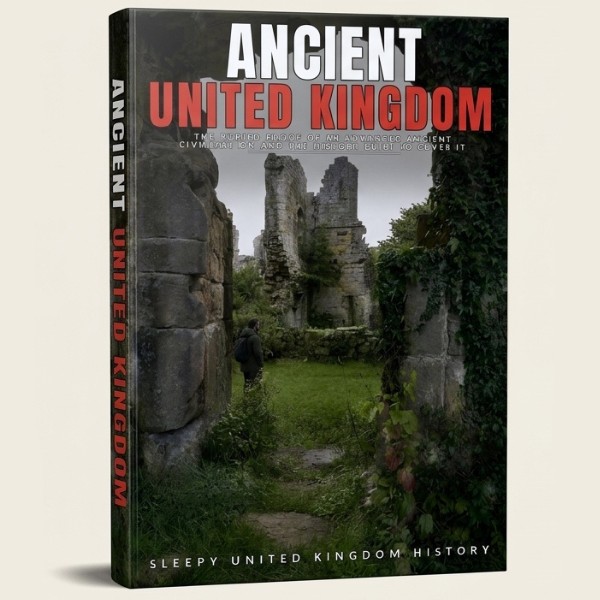
Ancient United Kingdom: The Buried Proof of an Advanced Ancient Civilization and the History Built to Cover It

Britain was not an island when its first people lived here, and most of what they left is under the North Sea. On land there are Orkney villages older than the pyramids, Bronze Age copper mines, and a Stonehenge that was partly re-erected in concrete within living memory. Every site in this illustrated guide is real and every date is published. It shows you what is buried, and how the story you were taught got built on top of it.

  • The country under the sea: Doggerland, the bones trawlers drag up in their nets, and wheat DNA at Bouldnor Cliff, 2,000 years before farming was supposed to arrive
  • Older than the pyramids: Skara Brae with its furniture still in place, the Ness of Brodgar, and Maeshowe's line of midwinter light
  • Engineering nobody mentions: the joinery in Stonehenge's stones, the Great Orme copper mine, Must Farm, and the sewn-plank boats of Ferriby and Dover
  • Dated to the year: Seahenge, felled in 2049 BC, plus the White Horse of Uffington, the Cerne Abbas Giant and what lidar found
  • The people: the Amesbury Archer, the composite mummies of South Uist, and the population that was replaced twice over
  • The history built to cover it: the barrow diggers, the Stonehenge restorations, Stukeley's druids and how the Celts were invented
Get the Book — $14.99
Instant download · Yours forever
Ancient United Kingdom: The Buried Proof of an Advanced Ancient Civilization, 3D book cover
$14.99Illustrated PDF
140pages90chapters7parts5appendices

Real Voices

“I've lived a few miles from Stonehenge for thirty years and had no idea how many of those stones were winched upright and set in concrete during the twentieth century. The chapter on the rebuild had me digging out old photographs that same night.”

Graham H. Graham H.61, Amesbury, Wiltshire

“Visitors ask me about the Ness of Brodgar every summer. The Maeshowe chapter finally gave me the dates and how they were worked out. It was The Limits at the end of each chapter that made me trust everything else.”

Claire D. Claire D.47, Stromness, Orkney

“I've walked up the Great Orme since I was a boy and never once thought about the tunnels under my boots. The copper mine chapter is the best few pages I've read all year, and Part Six made me properly angry.”

Owen R. Owen R.31, Llandudno, Wales
4.9 / 5 stars · over 8,000 readers of the buried record
Get the Book — $14.99
Instant download · Yours forever · Read on any phone, tablet or computer
I

You were told a shorter story than the one that happened

The version of Britain most of us learned starts late. There were some standing stones built by druids and some painted Celts, and then the Romans arrived with history in their luggage.

Almost none of that holds up. The druids were attached to Stonehenge by a clergyman in 1740. Most of the barrows were emptied in the nineteenth century by men who kept the gold and threw away the bones. The earliest chapters of the story are under sixty metres of cold water.

The record of ancient Britain is stranger, and better evidenced, than anything anyone has needed to make up.

There was no conspiracy in a back room. What happened was slower and harder to spot: repetition, inherited assumptions, national feeling and the enthusiasms of a few eighteenth and nineteenth century men. The discipline has corrected it again and again, but the corrections never reach the public as fast as the original mistakes did.

This book goes site by site. For each one you get what was dug up, how it was dated, what that implies, and exactly how the popular story went wrong.

II

The Difference

Viral videosThe guidebookThis book
Before the RomansA “lost civilization” with no nameDruids, Celts and a few stonesA drowned country, Orkney complexes, mines, boats and named burials
StonehengeAliens or giantsAn ancient thing standing where it always stoodWhat it is, where the stones came from, and how it was rebuilt
Dates“Older than anyone admits”Rounded and unexplainedPublished dates, with an appendix on what each dating method measures
The cover-upA secret societyNot mentionedBarrow diggers, Piltdown, nighthawking, and the reports nobody reads
HonestyNever admits doubtNever raises itEvery chapter ends with The Limits: what the evidence does not prove
Can you check it?NoNot reallySites worth visiting, plus where to look each one up yourself
III

What's Inside

Seven parts, ninety short chapters and five appendices. Below is a selection from the real table of contents.

Part One

The Country Under the Sea

Chapters 1–13 · the drowned land and the deep record

  • 01The Island That Was Not an Island
  • 03Mapping a Drowned Country With Oil Company Data
  • 06The Wheat That Should Not Have Been There
  • 07Footprints at Happisburgh
Part Two

The Builders

Chapters 14–26 · Orkney, Stonehenge, Avebury, Callanish

  • 14Skara Brae: A Village With the Furniture Still In It
  • 16Maeshowe and the Line of Midwinter Light
  • 21The Joinery Nobody Mentions
  • 23Silbury Hill
Part Three

The Technologies

Chapters 27–39 · mines, trackways, boats and brochs

  • 28The Great Orme Copper Mine
  • 32Must Farm
  • 34Sewn Boats: Ferriby and Dover
  • 39Sound Inside Stone
Part Four

The Marks on the Land

Chapters 40–51 · hill figures, cursuses and carvings

  • 40Seahenge
  • 41The White Horse of Uffington
  • 42The Cerne Abbas Giant
  • 51What the Lasers Found
Part Five

The People

Chapters 52–64 · the part that has changed most in ten years

  • 53The Amesbury Archer
  • 57The Replacement Nobody Expected
  • 59The Mummies of South Uist
  • 62What Cannibalism Looks Like Under a Microscope
Part Six

How the Record Was Broken

Chapters 65–78 · if you only read one part, read this one

  • 65The Barrow Diggers
  • 67Stonehenge Was Rebuilt
  • 73Piltdown
  • 77The Boxes in the Store
Part Seven

The Story Built on Top

Chapters 79–90 · who assembled the false story, and what would actually change it

  • 79Stukeley's Druids
  • 80The Invention of the Celts
  • 85The Day the Chronology Broke
  • 87What a Cover-Up Would Actually Look Like
Plus five appendices: A Timeline of Ancient Britain · Sites Worth Standing In · What Each Dating Method Actually Measures · Where to Look It Up Yourself · Twelve Claims You Will See Online
Get the Book — $14.99 Instant download · all 140 illustrated pages
IV

About the Book

Book cover

This book comes from Sleepy United Kingdom History. It is for anyone who has stood at a fence, looked at the stones, and felt they were getting a shorter story than the one that happened.

Every chapter follows the same pattern. First, what the site or finding is. Then the evidence: what was dug up, what was measured, and how it was dated. Then what that implies, stated no more strongly than the evidence allows.

Each chapter closes with The Limits, which spells out what has not been proved. You won't find invented artefacts, anonymous whistleblowers or photographs nobody can trace. Where specialists disagree, you get both sides.

V

Questions

Is this one of those “aliens built Stonehenge” books?

No. Nothing in it is made up. Every place named exists, and every excavation described actually happened. The “advanced civilization” in the title is the real one: Orkney complexes, copper mines and sea-going boats, all built by people who lived here. The “cover-up” is how that record was damaged, curated and written over, and the book says plainly where any claim goes further than the evidence.

The videos are free. Why buy the book?

A video gives you one site and one claim. The book gives you ninety chapters, each with the evidence, how it was dated, and its limits. It also has a timeline, a list of sites worth visiting, a guide to dating methods, and a chapter-by-chapter look at twelve claims you'll see online.

Why only $14.99?

We want this to be the first book people pick up on the subject, and a low price helps. This is the launch price and it may go up later.

What format is it, and how do I get it?

It's an illustrated 140-page PDF. When you finish checkout on Gumroad, the download is ready right away and a copy is emailed to you. It opens on any phone, tablet, computer or e-reader that reads PDFs, and it's yours to keep.

Do I have to read it in order?

No. The chapters are short and the seven parts don't depend on each other. The book itself suggests starting with Part Six, or with the chapter on how Stonehenge was rebuilt.

Can I visit these sites?

Many of them, yes, and an appendix lists the ones worth standing in. Some are on private land or protected, so check access before you travel. Nothing in the book is an invitation to dig, detect, climb or collect.

It is all still there. It always was.

90 short chapters, 7 parts and 5 appendices, so you can go and stand at the stones knowing more than the guidebook tells you.

Get the Book — $14.99
Instant download · Yours forever